
FIFA World Cup Stats: Complete Guide to Goals, Records and 2026
Finding accurate FIFA World Cup stats can be frustrating when you need goals, player records, match results, historical tables, and the latest 2026 tournament information in one place. Missing or outdated figures can make it difficult to compare teams and understand historic performances. This guide brings together key tournament records, past World Cup results, Cristiano Ronaldo’s statistics, and the numbers to follow during 2026, while distinguishing established historical facts from live results that require current verification.
What Are FIFA World Cup Stats?
FIFA World Cup stats are the numbers that explain how teams and players perform at football’s biggest international tournament. They cover goals, assists, appearances, wins, defeats, clean sheets, possession, cards, penalties, and championship records.
Fans, journalists, analysts, and football website owners use these figures to compare performances across different tournaments. The most useful statistics combine the final score with context, such as the opponent, match stage, minutes played, and competition format.
Key statistics include:
- Team statistics: Wins, draws, losses, goals scored, and goals conceded.
- Player statistics: Appearances, goals, assists, and individual records.
- Tournament statistics: Champions, runners-up, total matches, and final scores.
- Live match statistics: Shots, possession, corners, cards, and substitutions.
- Historical statistics: Records from the 1930 tournament through the latest completed edition.
FIFA World Cup Stats 2026: Tournament Overview
The 2026 FIFA World Cup introduced a major change by expanding the competition to 48 national teams. Canada, Mexico, and the United States jointly hosted the tournament, which concluded on July 19, 2026.
Spain defeated Argentina 1–0 after extra time in the final. Ferran Torres scored the decisive goal in the 106th minute, giving Spain its second men’s World Cup title.
| Tournament statistic | FIFA World Cup 2026 |
|---|---|
| Host countries | Canada, Mexico, United States |
| Participating teams | 48 |
| Total matches | 104 |
| Group format | 12 groups of four |
| Group-stage matches | 72 |
| Knockout rounds begin | Round of 32 |
| Opening date | June 11, 2026 |
| Final date | July 19, 2026 |
| Champion | Spain |
| Runner-up | Argentina |
| Final score | Spain 1–0 Argentina, after extra time |
| Decisive scorer | Ferran Torres |
| Winning goal time | 106th minute |
The expanded format gave more national teams an opportunity to compete. It also added a Round of 32, meaning finalists had to play eight matches rather than seven.
FIFA World Cup Stats Today: What Should You Check?
People searching for FIFA World Cup stats today usually want the latest completed results, match information, team standings, or individual performances. Because the 2026 tournament has finished, today’s information should distinguish historical World Cup records from any new football matches taking place outside the competition.
For a useful daily statistics report, check these categories:
- Latest results: Final scores and match dates.
- Goal scorers: Players who scored, including penalty and extra-time goals.
- Team standings: Points, goal difference, goals scored, and matches played.
- Player performance: Goals, assists, appearances, and disciplinary records.
- Knockout bracket: Qualified teams, completed rounds, and final outcomes.
- Historical comparisons: How current records compare with earlier World Cups.
A reliable report should show when the data was updated. It should also identify whether a number refers to the men’s senior FIFA World Cup, a qualifying competition, a friendly, or another tournament.
FIFA World Cup Stats All Time: Most Important Records
Historical records help explain how football has changed over nearly a century. Some players built their reputations through goals, while others became famous for winning multiple titles or appearing in several editions.
The following table highlights established all-time records and significant milestones through the 2026 tournament.
| Record | Player or team | Achievement |
|---|---|---|
| Most men’s World Cup titles before 2026 | Brazil | 5 titles |
| Most World Cup appearances by a player | Lionel Messi | 34 matches |
| Most World Cup goals before 2026 | Miroslav Klose | 16 goals |
| Highest-scoring player in World Cup history after 2026 | Kylian Mbappé | 22 goals |
| Most World Cup goals by a Brazilian player | Ronaldo Nazário | 15 goals |
| Most goals in a single men’s World Cup edition | Just Fontaine | 13 goals in 1958 |
| Most World Cup wins by a player | Miroslav Klose | 17 victories |
| 2026 champion | Spain | Second title |
| 2022 champion | Argentina | Third title |
| 2018 champion | France | Second title |
These records measure different achievements. A player’s total goals across several tournaments are not directly comparable with the number of goals scored during a single edition.
The 2026 tournament also changed the historical scoring leaderboard. Kylian Mbappé finished with 22 World Cup goals, surpassing the previous record of 16 held by Germany’s Miroslav Klose.
FIFA World Cup Stats Goals 2026: Top Scoring Records
Goals are among the most searched football statistics because they reveal both individual brilliance and team effectiveness. The 2026 tournament added new milestones to the competition’s scoring history.
Kylian Mbappé became the leading men’s World Cup scorer with 22 goals, while Lionel Messi also moved beyond Klose’s former record. These totals cover the players’ World Cup careers, not just their performances in 2026.
Important goal statistics include:
- Total career goals: All goals a player scores in World Cup final tournaments.
- Single-tournament goals: Goals scored in one edition.
- Goals per match: Total goals divided by appearances.
- Penalty goals: Goals scored from penalty kicks during matches.
- Extra-time goals: Goals scored after the end of regulation time.
- Knockout goals: Goals scored in elimination matches.
- Winning goals: Goals that establish the decisive lead in a match.
When comparing scorers, always use the same competition scope. Qualifying-round goals and international friendly goals should not be added to final-tournament totals unless the statistic explicitly covers all international football.
FIFA World Cup Stats 2026 Table: Understanding Team Standings
A World Cup table shows how teams perform within their groups. During the 2026 group stage, teams competed for places in the knockout rounds, with the top two sides in each group and the eight best third-placed teams progressing.
A standard group table includes the following columns:
| Abbreviation | Meaning | What it tells you |
|---|---|---|
| P | Played | Matches completed |
| W | Won | Matches won |
| D | Drawn | Matches ending level |
| L | Lost | Matches lost |
| GF | Goals for | Total goals scored |
| GA | Goals against | Total goals conceded |
| GD | Goal difference | GF minus GA |
| Pts | Points | Total points earned |
Teams normally receive three points for a win and one point for a draw. A defeat earns no points.
For example, a team with two wins and one draw finishes its group matches with seven points. If it scores six goals and concedes two, its goal difference is +4.
Important: A team can score more goals than another team and still finish lower in the table if it earns fewer points. Goal difference and other official tiebreaking criteria help determine rankings when teams finish level on points.
FIFA World Cup Stats Bracket: How the Knockout Stage Works
The World Cup bracket shows the path from the group stage to the final. In the 2026 format, 32 teams advanced to the Round of 32, followed by the Round of 16, quarter-finals, semi-finals, third-place match, and final.
The knockout structure was:
- Round of 32 — 32 teams compete in 16 matches.
- Round of 16 — 16 teams compete in eight matches.
- Quarter-finals — Eight teams compete in four matches.
- Semi-finals — Four teams compete in two matches.
- Third-place match — The two semi-final losers compete for third place.
- Final — The remaining two teams compete for the championship.
A bracket is different from a league table. Teams cannot recover from a knockout defeat by earning points in another group match; they must win their elimination match to advance. If a knockout match remains level after regulation time, extra time and, when necessary, a penalty shootout can decide the winner.
FIFA World Cup Stats 2022: Argentina’s Championship
The 2022 FIFA World Cup took place in Qatar from November 20 to December 18. Argentina won the tournament by defeating France in a memorable final that finished 3–3 after extra time before Argentina prevailed 4–2 in the penalty shootout.
Key tournament facts
| Statistic | Record |
|---|---|
| Host country | Qatar |
| Participating teams | 32 |
| Champion | Argentina |
| Runner-up | France |
| Final score after extra time | Argentina 3–3 France |
| Penalty shootout | Argentina won 4–2 |
| Golden Boot winner | Kylian Mbappé |
| Mbappé’s tournament goals | 8 |
| Golden Ball winner | Lionel Messi |
| Third place | Croatia |
Argentina’s victory gave the country its third men’s World Cup title, following its championships in 1978 and 1986. Messi scored twice in the final, while Mbappé scored a hat-trick for France.
These FIFA World Cup stats show why the final remains a major reference point for comparisons involving attacking performances, penalty shootouts, and championship matches.
FIFA World Cup Stats 2018: France’s Winning Campaign
France won the 2018 tournament in Russia, beating Croatia 4–2 in the final. The competition featured 32 teams and 64 matches, with several memorable individual performances.
| Statistic | Record |
|---|---|
| Host country | Russia |
| Champion | France |
| Runner-up | Croatia |
| Final score | France 4–2 Croatia |
| Golden Boot winner | Harry Kane |
| Kane’s goals | 6 |
| Third place | Belgium |
| Fourth place | England |
| Total matches | 64 |
| Participating teams | 32 |
France’s campaign combined attacking quality with effective performances throughout the knockout rounds. Croatia reached its first men’s World Cup final, while Belgium secured third place after defeating England.
Cristiano Ronaldo also made headlines in 2018. He scored four goals, including a memorable hat-trick against Spain in Portugal’s opening match.
FIFA World Cup Stats 2014: Germany’s Historic Victory
Germany won the 2014 World Cup in Brazil by defeating Argentina 1–0 after extra time. Mario Götze scored the winning goal in the 113th minute, giving Germany its fourth men’s World Cup championship.
| Statistic | Record |
|---|---|
| Host country | Brazil |
| Champion | Germany |
| Runner-up | Argentina |
| Final score | Germany 1–0 Argentina |
| Golden Boot winner | James Rodríguez |
| Rodríguez’s goals | 6 |
| Third place | Netherlands |
| Fourth place | Brazil |
| Total matches | 64 |
| Participating teams | 32 |
One of the tournament’s defining moments came in the semi-final, when Germany defeated host nation Brazil 7–1. Miroslav Klose scored his record-breaking 16th World Cup goal during that match.
The 2014 edition remains important for historical comparisons involving goals, team efficiency, and the performances of experienced international players.
Cristiano Ronaldo FIFA World Cup Stats
Cristiano Ronaldo has represented Portugal at six men’s FIFA World Cups: 2006, 2010, 2014, 2018, 2022, and 2026. His career illustrates how a player’s role, team results, and scoring contributions can change across different editions.
According to FIFA’s post-tournament historical records, Ronaldo finished with 11 World Cup goals in 27 appearances.
| World Cup edition | Portugal’s tournament result | Ronaldo’s goals |
|---|---|---|
| 2006 | Fourth place | 1 |
| 2010 | Round of 16 | 1 |
| 2014 | Group stage | 1 |
| 2018 | Round of 16 | 4 |
| 2022 | Quarter-finals | 1 |
| 2026 | Round of 16 | 3 |
| Career total | Six editions | 11 |
Ronaldo’s four goals in 2018 made that edition his most productive World Cup before 2026. His 2026 goals extended his record of scoring at six separate editions of the men’s tournament.
How Ronaldo’s Record Compares With Messi’s
Ronaldo and Lionel Messi have both competed across multiple World Cups, but their records differ in appearances, goals, and team achievements.
| Statistic | Cristiano Ronaldo | Lionel Messi |
|---|---|---|
| World Cup editions | 6 | 6 |
| Appearances through 2026 | 27 | 34 |
| Career World Cup goals | 11 | 21 |
| World Cup titles | 0 | 1 |
| Best finish | Fourth place, 2006 | Champion, 2022 |
Messi’s 34 appearances established a new all-time record for men’s World Cup matches. His 21 goals also placed him above every other player in the historical scoring records available after the 2026 tournament.
The comparison demonstrates why goals alone do not tell the complete story. Appearances, team progress, assists, leadership, and individual awards provide additional context.
FIFA World Cup Stats Mexico: Hosting History and 2026
Mexico has played an important role in men’s World Cup history. It hosted the tournament in 1970 and 1986 and became one of three host countries for the 2026 edition alongside Canada and the United States.
Mexico’s involvement in 2026 also marked a historic hosting milestone: it became the first country to host men’s World Cup matches at three different editions.
| Year | Mexico’s role | Key detail |
|---|---|---|
| 1970 | Host country | Brazil won the tournament |
| 1986 | Host country | Argentina won the tournament |
| 2026 | Co-host | Shared hosting with Canada and the United States |
Mexico City’s Estadio Azteca, known as Mexico City Stadium during the 2026 competition, is closely associated with the country’s football heritage. The stadium hosted major matches in earlier editions and remained a landmark venue in 2026.
When researching Mexico’s World Cup statistics, separate the country’s performance as a national team from its record as a tournament host. Hosting history and match results describe two different aspects of the competition.
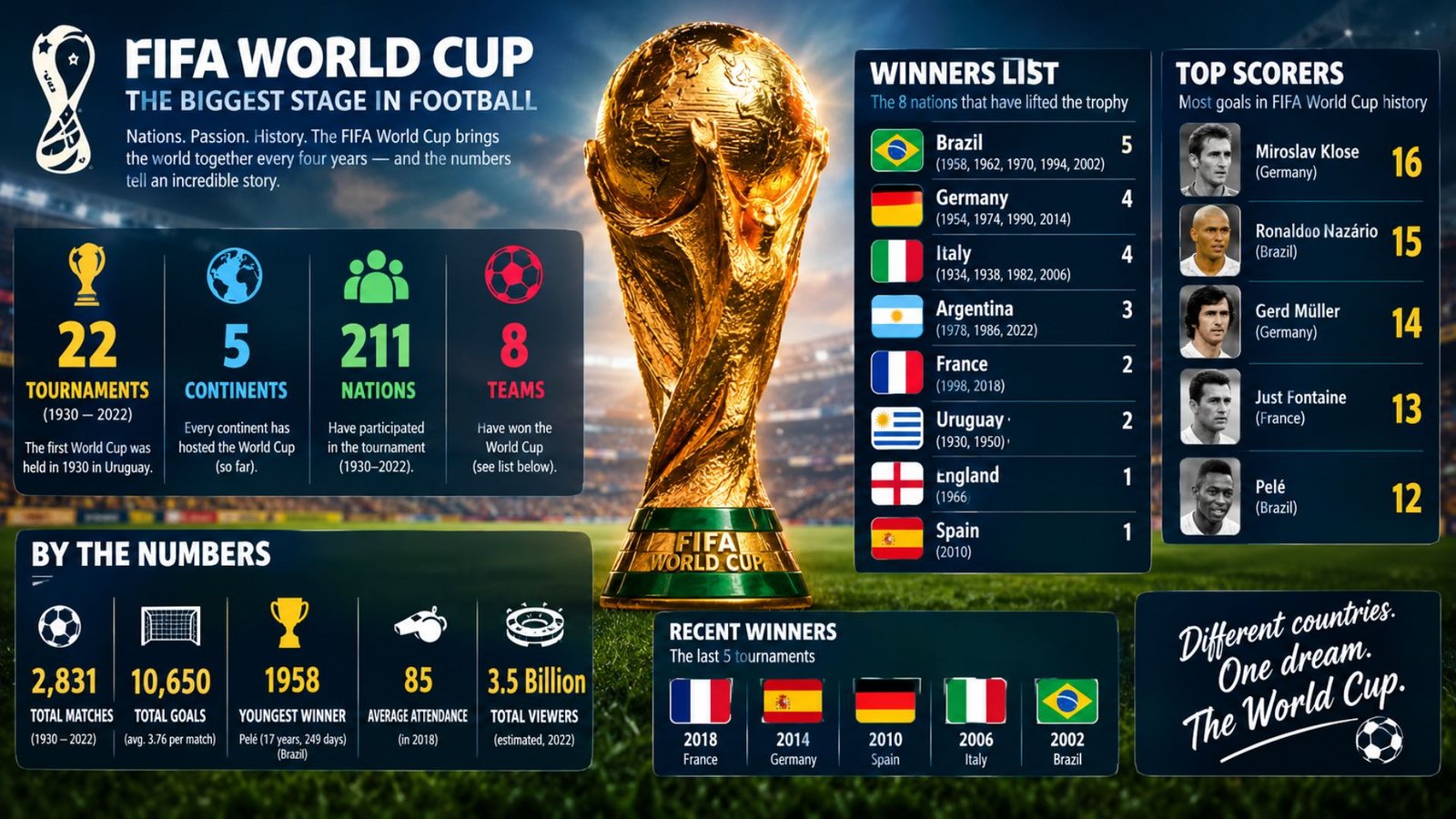
Which Country Has Won the Most FIFA World Cups?
Brazil held the record for the most men’s World Cup championships before the 2026 edition, with five titles. The 2026 tournament added Spain as a two-time champion after its victory over Argentina.
The following table lists countries with multiple men’s World Cup titles, including their results through 2026.
| National team | Titles | Championship years |
|---|---|---|
| Brazil | 5 | 1958, 1962, 1970, 1994, 2002 |
| Germany | 4 | 1954, 1974, 1990, 2014 |
| Italy | 4 | 1934, 1938, 1982, 2006 |
| Argentina | 3 | 1978, 1986, 2022 |
| France | 2 | 1998, 2018 |
| Uruguay | 2 | 1930, 1950 |
| Spain | 2 | 2010, 2026 |
| England | 1 | 1966 |
Germany’s 1990 championship was won as West Germany. FIFA recognizes that title within Germany’s historical championship record.
The table also shows that winning multiple World Cups requires success across different generations of players, coaches, and tactical approaches.
How to Read FIFA World Cup Stats Live
Live statistics help fans understand a match beyond the scoreline. A team can have more possession yet create fewer dangerous chances, while another team can defend patiently and score from a counterattack.
The most useful live metrics are:
- Possession: The percentage of playing time a team controls the ball.
- Shots: Attempts to score, including efforts that miss the target.
- Shots on target: Attempts that would enter the goal without a save or another intervention, under the competition’s statistical definition.
- Expected goals (xG): A model-based estimate of the likelihood that a shot becomes a goal.
- Corners: Corner kicks awarded to each team.
- Pass accuracy: The percentage of completed passes.
- Yellow and red cards: Disciplinary actions recorded by the referee.
- Saves: Attempts stopped by the goalkeeper.
Live numbers can change during a match as statisticians review events. For accurate reporting, distinguish provisional live data from the final match statistics published after the game.
FIFA World Cup Stats 2024: Was There a Men’s World Cup?
There was no senior men’s FIFA World Cup final tournament in 2024. The most recent men’s editions around that period were Qatar 2022 and the expanded 2026 tournament.
However, 2024 included other major international football competitions, such as UEFA EURO 2024 and the Copa América. These tournaments have their own records, teams, match statistics, and championship histories.
If a page uses the phrase “FIFA World Cup stats 2024,” check whether it refers to:
- Historical World Cup records reviewed or published in 2024.
- World Cup qualification matches played during that year.
- Another international football competition.
- A website’s publication date rather than the date of the World Cup itself.
This distinction helps prevent incorrect dates and misleading statistics from appearing in sports articles.
How to Find Accurate FIFA World Cup Stats
Reliable statistics depend on clear definitions and trustworthy records. FIFA’s official tournament records are the primary reference for final scores, match appearances, player goals, championship results, and tournament formats.
Use this checklist when preparing a football statistics report:
- Identify the competition. Confirm that the data covers the men’s senior World Cup rather than qualifying matches or a youth tournament.
- Check the tournament year. Make sure historical and current-edition figures are not mixed together.
- Confirm the player’s identity. Distinguish Cristiano Ronaldo from Brazil’s former striker Ronaldo Nazário.
- Check the match stage. Group-stage, knockout-stage, and final statistics can answer different questions.
- Verify totals. Add individual match figures only when they use the same statistical definition.
- Record the update date. This is especially important for live results and changing tournament records.
- Use primary sources. Prefer official FIFA match reports and tournament records over unsourced social media posts.
For publication, include an author name and a short methodology note explaining how the numbers were checked. An article that clearly identifies its data sources and update policy gives readers more reason to trust its information.
Why FIFA World Cup Statistics Matter to Football Fans
Statistics turn memorable football moments into measurable records. They help fans compare generations, evaluate individual contributions, and understand why certain teams consistently reach the latter stages of major tournaments.
They are also useful for fantasy football research, sports journalism, historical analysis, and football education. A reader can use scoring rates to compare forwards, clean sheets to assess goalkeepers, or goal difference to understand the strength of a team’s group-stage campaign.
The most meaningful analysis combines numbers with context. A goal scored in a final, for example, may carry greater historical significance than a goal scored in a group match, even though both count equally toward a player’s official tournament total.
Frequently Asked Questions About FIFA World Cup Stats
1. Who has scored the most goals in FIFA World Cup history?
Kylian Mbappé finished the 2026 men’s World Cup with 22 career tournament goals, making him the all-time leading scorer in the historical records available after that edition. Lionel Messi finished second with 21 goals.
2. Which country has won the most FIFA World Cups?
Brazil holds the men’s tournament record with five championships, won in 1958, 1962, 1970, 1994, and 2002.
3. Who won the FIFA World Cup 2026?
Spain won the 2026 tournament by defeating Argentina 1–0 after extra time in the final. Ferran Torres scored the decisive goal in the 106th minute.
4. How many goals has Cristiano Ronaldo scored in the FIFA World Cup?
Cristiano Ronaldo scored 11 goals across six men’s World Cup editions, from 2006 through 2026. He made 27 appearances in those tournaments.
5. What is the difference between World Cup standings and a bracket?
Standings rank teams using points, wins, draws, goals, and applicable tiebreakers during the group stage. A bracket shows the knockout path, where a team must win its elimination match to advance.
6. Where can I find accurate FIFA World Cup stats today?
FIFA’s official tournament records are the primary source for historical results, player records, final scores, and tournament information. Check the date and competition scope before using figures in an article.
Conclusion
FIFA World Cup stats provide a clear way to explore football history, compare legendary players, and understand the performances that define international tournaments. From Brazil’s five championships to Messi’s record 34 appearances and Mbappé’s 22 career World Cup goals, these numbers capture achievements that fans remember for generations.
The 2026 tournament added another historic chapter, with Spain defeating Argentina to claim its second title. For the most accurate analysis, compare statistics using consistent definitions, verify historical records, and keep tournament information updated.
Which World Cup record impresses you the most? Share your favourite player, team, or unforgettable final and join the conversation about football history.
Editorial source and trust note
The historical facts and 2026 tournament information in this article are based on official FIFA tournament reports, FIFA’s World Cup records, and FIFA’s published player statistics. For future updates, verify changing records against the latest official match reports.
SEO note: This article is structured for search intent, readability, and answer-focused discovery. No article can guarantee a first-page Google ranking or a specific E-E-A-T score; performance depends on accuracy, site quality, competition, and ongoing updates.